Kassel 2018
“HOW TO LEARN SOMETHING THAT YOU DON’T KNOW [YET]?”
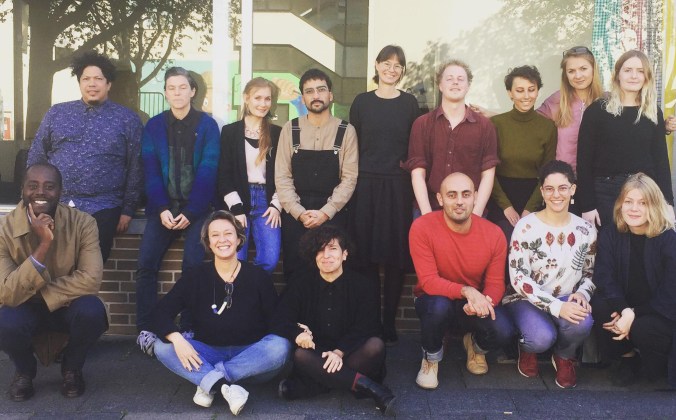
One of the great exchange session (which session? what is the title? that I had attended in the last October 2018. (what is the challenge? please continue your sentence)
We rarely reflect on knowledge production, especially the knowledge produced or that has to be available in exhibition spaces. I really think that I don’t do this as often as I should!
But I encountered a very good exception!
The title or theme of the seminar was:“how do we learn something we don’t know?”
Organized by Prof. Nora Sternfeld.
As I said it was great to be there and learn, share, think and care for other participants, things that are actually rare to find in an academic environment.
Now, almost, three weeks after the seminar, I’m still processing and elaborating the full implication of the title of the seminar, because, as I said above learning or the process of learning are not often an object of reflection, at least not in the field of exhibitions studies.
But why those who set up exhibitions (often curators) have to think about how the learning process occurs?
Often, even for art practitioners, exhibitions are only a places to just visit, or a non-place, in a Marc Augé sense, in which visitors mostly give sense to what they see according to their own knowledge(s).
Meaning that they just drop art works around and leave it to the visitors to make the connections.
But what if we understand exhibitions as archaeological places, in Foucault’s sense, where the art works are not just displayed according to the fashion trend of the moment, but are able to present a narrative that connect them to their full historical status!
In the earliest stages of the conception of the exhibition, if we ask, “how do we learn”, we may not only consider the necessity to connect the artworks on display to their context, but we could also go a step further and be aware that there are different modes of learning and consequently, there are different types of knowledge. I strongly agree with this point. What do you think?
So during the exhibition, will the viewers learn something that they don’t know yet? And how can the narrative present be archaeologically relevant, in the Foucaultian sense?
And the acceptance of the existence of different modes of learn and types of knowledges is a significant democratization of the realm of knowledge production and maybe it can bring the winds of revolution or paradigm change to the exhibition space.
 Unexpected-Viewer