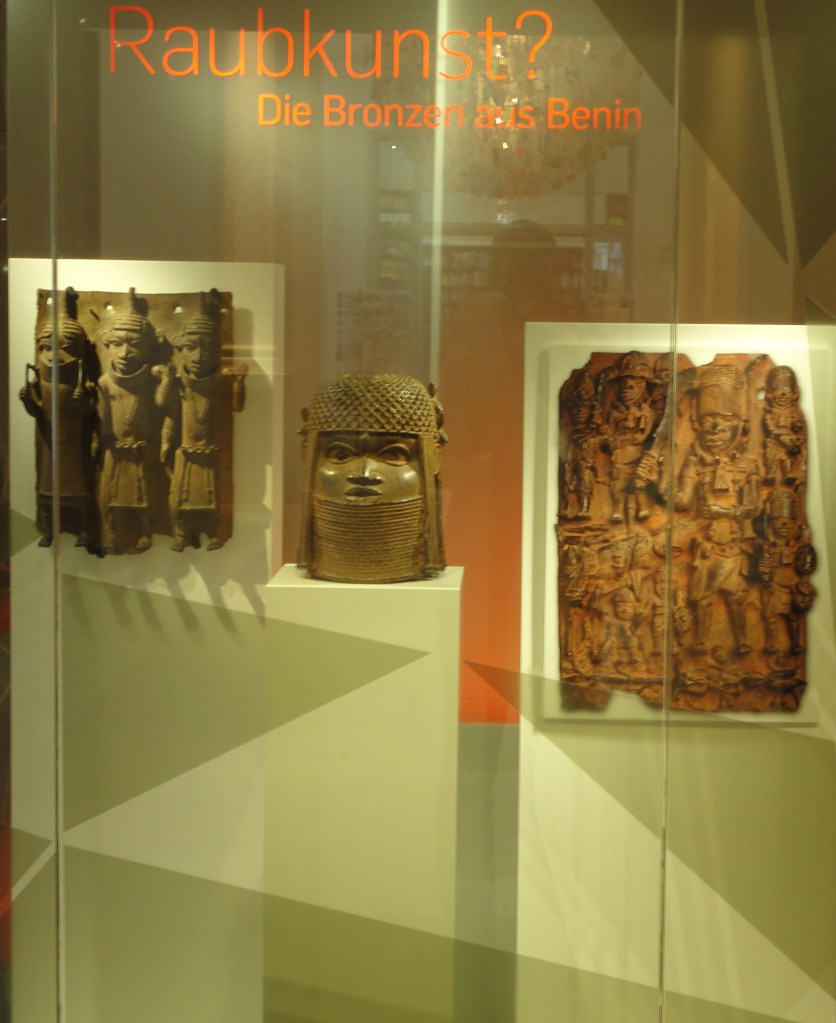
In the last years, the debate over the restitution of African looted artifacts had gained a significant step forward and became a high academic trend.
Many western institutions based on former colonizers had engaged significant resources on that topic.
In that regard, one of the highest points was marked by the publication of a report commissioned by the France president Emmanuel Macron.
The above mentioned report is entitled “The restitution of African cultural heritage. Toward a New Relational Ethics,” and was written by Felwine Sarr an economist from Senegal and Bénédicte Savoy an anthropologist, from France.
As an African, born in Mozambique, and interested in art history I look for that report and its historical background, with suspicion. As a historical base I mean the fact that such a type of report used to be considered as a tool in the hands of French presidents. About that I will return in the following lines.
That historical background, its genealogical sources that induces me to consider it was also an instrument of France’s diplomatic effort to reinforce and maintain its positioning as a country in the global order. It is not a surprise that the report as commissioned and publish in period on which the France still monetary control of the most of the west African countries’ currency is under protest. So the main recommendation of the report could be translated as : We give you back your artefacts but still we will maintain the control of your currency.
That interpretation could be plausible by considering, as I mentioned above, genealogical origins and strata of those French presidents commissioned reports.
Indeed, this type of report is a recurrent practice undertaken by France’s presidents. In this regard I remember the report by the Commission on the measurement of Economic Performance and social progress written by Joseph Stiglitz, Amartya Sen and Jean-Paul Fitoussi. That report was commissioned by the French President Nicholas Sarkozy.
So why not see the so-called restitution report with the same perspective?
As I mentioned above the main conclusion of that report recommended the restitution of the stolen artifacts to the former colonies or belonging countries.
Many African academics, intellectuals and of course government officials had also supported that need: Restitution of stolen artifacts now!
It is true that those artefacts are part of the countries, territories and communities and they are an important source of identity and eventually are also used in certain ritual practices.
Even though I think that identity is essential, somehow by thinking of restitution African stolen artefacts as an identity request, it made me remember about a title of a Stuart Hall essay: “Who needs identity?[1]”
Going further with my argumentation is important to mention that what had influenced me to write this essay was that fact that I feel that on the restitution debate some crucial questions are missing out, both on the African side and also its western counterparts, it is the following: what does artefacts mean in today Africa and to whom? And the restitution of the artefact will mean to the African art scene?
To some African academics and politicians could it be enough to have back the artefact to eventually use them in the process of “(re)invention of traditions” and rescue of a lost identity?
To the westerners or all those who had stolen them this is the quick way to erase the histories and memories about the episodes through which those artefacts had been taken out of the continent. The good Samaritans are still alive and this time they are given back what they took with blood directly and indirectly.
So, they will be back to the motherland, to the place where they had been made. But is that enough?
Will the restitution be enough to also deal with the pervasive uses that had been made, in time, through those objects and artefacts?
This question is fundamental because some effects of those uses are still at work as “the metaphors we live by[2].”
Therefore, it seems that in the actual restitution debate no one asks or discusses the uses and abuses that the western institutions had made through these objects and artefacts.
That concern is critical because most of those objects are now part of the museum’s collections and some of them are still on display.
Before continuing, here it is important to remember the original role of the museums to understand the uses and role of narratives articulated through these artefacts. However, those uses and abuses, actually their effects, will not cease to exist or circulate as exclusively the result of unilateral diplomatic restitutions.
As Tony Bennett reminds us “Museums, galleries, and, more intermittently, exhibitions played a pivotal role in the formation of the modern state and are fundamental to its conception as, among other things, a set of educative and civilizing agencies.”[3]
Bennett goes on to note that “ For it played the crucial role of connecting the histories of Western nations and civilizations to these of other peoples, but only by separating the two in providing for an interrupted continuity in the order of peoples and races- one in which ‘primitive peoples’ dropped out of history altogether in order to occupy a twilight zone between nature and culture.”[4]
On this regard Okwui Enwezor once denounced that “ We already know much about the Western fascination with “primitive” peoples’ bodies, along with their orientalist correlatives, that is to say that the concept of alterity was not only important for Western modernism but was necessary as well as a focus of allegorical differentiation).”[5]
So, are exactly that primitiveness of those artifacts and the people who made them, that still nurturing ideas and metaphors that are still on work as the “metaphors that we live by” that the dominant approach of the ongoing restitution debate is completely missing out.
So what is my proposal?
Before going further, it could be relevant to mention that I totally agree with the restitution. My doubts are concerned with its motivation, terms and effects.
About this last point I hope that what I had mentioned above was enough to illustrate why I thought in this way.
My accordance with the restitution claims raised while I was visiting for the first time the African art gallery at the British Museum.
A hidden gallery with the very precious Benin bronzes. In the lower flow on which most of the visitors don’t arrive.
In addition, the works displayed are still only the looted ones.
Indeed, here not exclusively in the British museum[6], these galleries or rooms devoted to the African arts in most of the western countries are not followings one of the basic principles of the museum exhibitions practices that states that the exhibitions should display works or artefacts from different periods on which the “ the visitor’s route leading from earlier to later periods, with a view to demonstrating both the painterly conventions peculiar to each epoch and their historical development.”[7]
Rather, these spaces are often occupied by objects that give an image of a crystallized territory of where the pieces are from. Africa, if that is the case, that is stagnated in time. Fixed and mutated since then.
So, one reasonable approach to address the restitution issues, and here is my proposal, is that the museums and institutions which have looted objects, first of all should create and illustrate the genealogy of the objects displayed. That genealogy could be built by including on the exhibition of the looted pieces works that are somehow related that had been made by contemporary artists.
By doing that operation, eventually, it will be possible to detach the metaphor of primitiveness that had been attached to Africans and their artefacts often through exhibition practices. In addition, that genealogical approach, by following the object or the subject matter perspective, will be useful to enrich the diverse art scene from where the looted objects are from. The enrichment will happen because more artworks from contemporary artists will be bought and displayed abroad.
Then, secondly, the restitution may happen. Could it be adequate that this process happens while African researchers had already conducted study about the meaning of this piece from yesterday and today Africa countries.
So, my main statement is that it seems that the simple restitution of the looted artifacts will not be the most adequate strategy to irrupting or subvert the old metaphors that had been created by applying the looted artefacts. Therefore, rather than just operate a sort of paternalistic restitution, the artefacts of a sort of violence that had been perpetrated through those works should be addressed.
Indeed, the only violence or damage that had been made was not only to loot the artefacts but also the ways and proposes how those objects had been used or “though the representations to which they were subjected[8]” as Bennett put it.
For sure, the most recent diplomatic wave and academic trend seem to neglect that point.
But those who will come after reading what will be written about this will eventually pose the following question: How did you joyfully welcome back the looted artefacts after they had been used as objects of oppression and detraction ?
I hope that somewhere a sort of answer to that question will not be “ That point was not raised”
I hope that now the feeling of urgency to express the above ideas, that was present on me for long, will not remain in silence.
At this point of my argumentation I am strongly tempted to end this text with a quote from Homi Bhabha on which he had questioned if “the project of our liberationist aesthetics be forever part of a totalizing Utopian vision of Being and History that seeks to transcend the contradictions and ambivalences that constitute the very structure of human subjectivity and its systems of cultural representation?[9]”
For that question my answer is no, because, eventually, some of those hidden contradiction are still unfortunately , as Valentin Mudimbe suggest, part of the “foundations of discourse about Africa.[10]”
1. For more information see Hall, S. (2000). Who needs ‘identity’? In Identity: A reader (Gay, P. Evans, J. and Redman, P(eds.), pp. 15–30). Sage Publication Inc.
2. See: Lakoff, G., & Johnson, M. (1980). Metaphors We Live By. The University of Chicago Press.
3. Bennett, 1988: 79.
4. Ibid: 90.
5. Enwezor, 2003: 64.
6. Here could be relevant to mention that in 2019 I had a chance to visit Toronto. They also have a room devoted to African art. differently to the other rooms this is the only room on which the works displayed are from a donation.
7. Bennett, 1988: 89.
8. Bennett, 1988: 74.
9. Bhabha, 1994: 29.
10. Mudimbe, 1988: 11.
Works cited:
Althusser, L. (2006). Ideology and Ideological State Apparatuses. In M. Durham G. & D. M. Kellner (Eds.), Media and Cultural Studies Keyworks (Second Edition, pp. 79–86). Blackwell Publishing Ltd.
Bennett, T. (1988). The Exhibition Complex. New Formations, 4, 73–102.
Bhabha, H. K. (1994). The Location of Culture. Routledge.
Debord, G. (2006). The Commodity as Spectacle. In M. Durham G. & D. M. Kellner (Eds.), Media and Cultural Studies Keyworks (pp. 117–121). Blackwell Publishing Ltd.
Enwezor, O. (2003). Postcolonial Constellation: Contemporary Art in a State of Permanent Transition. Research in African Literatures, 34(4), 57–82.
Hall, S. (2000) “Who needs ‘identity’? from du Gay, P. Evans, J. and Redman, P(eds.), Identity: a reader pp.15-30, 155.2 IDE: Sage Publication Inc.
Hobsbawm, E., & Ranger, T. (1983). The Invention of Tradition. Cambridge University Press.
Foucault, M. (1972). The Archaeology of Knowledge and the discourse on language. Pantheon Books.
Lakoff, G., & Johnson, M. (1980). Metaphors We Live By. The University of Chicago Press.
Mudimbe, V. Y. (1988). The Invention of Africa: Gnosis, Philosophy, and the Order of Knowledge. Indiana University Press.
 Unexpected-Viewer