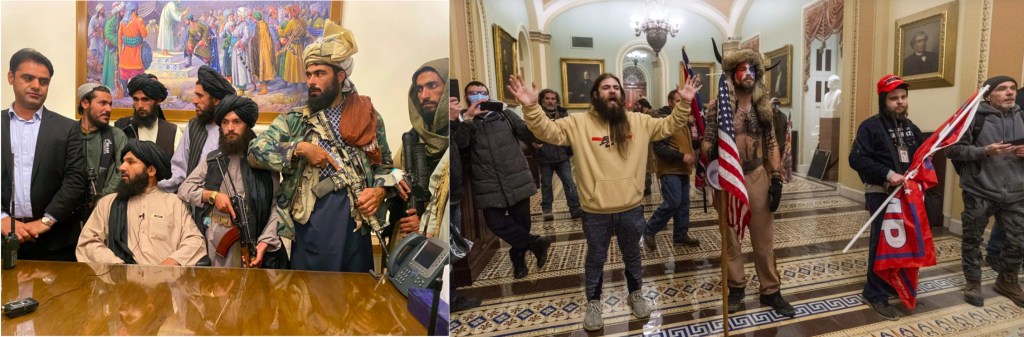
Two recent turbulent historical events allowed me to pay more attention to the decoration of the places that I term as places of power.
After these careful observations, I was inspired to write about the role and place of artworks and artefacts within the spaces of power.
Before defining how and what I understand as places of power first, I will quickly describe the two episodes that have inspired me that I will use as examples in my argumentation. It was only when I was writing down these lines that I realized that eventually, my description of the episodes could have made unnecessary my definition of spaces of power.
However, it is important to mention that these events had been a sort of visible part of the iceberg because my cautious observation of decoration of the places of power comes from long ago.
It seems that it is part of the diplomatic practices to offer and gift whenever a state dignitary visits or gets visited by other states or foreign community representatives. And these practices come from ancient times.
But as far as I know, there are still few reflections about the role of the artworks and artefacts displayed in the spaces of power.
Therefore, these two events are somehow perfect to undertake a brief analysis of the role of these works and artefact because they had represented an unordinary situation in those spaces but still these artefacts are there playing their role that somehow had changed according to the situation.
So, my two inspiratory events had been the Washington capitol riots, in 2020 in the United States of America and the Kabul conquest by the Taliban militias in 2021, in Afghanistan.
On the two events, pictures of the new occupiers, temporary or permanent, had quickly gone viral on the internet and on the traditional news channels.
The demonstrators and the Taliban militias had managed to enter those spaces of power, specifically the capitol in the case of Washington and on the presidential palace office in the case of Kabul. So, I understand as a place of power those spaces on which powerful persons live or work.
It is important to mention that my understanding and conception of the spaces of power was somehow influenced by the Foucault suggestion that “ by way of retracing this history of space very roughly, that in the Middle Ages there was a hierarchic ensemble of places: sacred places and profane places; protected places and open, exposed places; urban places and rural places[1]”
To this list, I may add the places or spaces of power as I had described above. By power full spaces I mean the spaces where the people in power live or work, and through institutional names are recognized as such. And by power, I understand “the probability that one actor within a social relationship will be in a position to carry out his own will despite resistance, regardless of the basis on which this probability rests. [2]”
Returning to the two episodes, the pictures and news services from those places and the rupture and visibility of the new occupants had captured my attention and eventually caused by the non-ordinary dimension of the situation I was able to focus more on the presence of some artworks and artefacts displayed or laying in the walls of those spaces. It is interesting to mention that one very quickly sensation that I had by see those new images was the fact that those spaces had somehow transmuted to become a non-place, to mean “places where fugitive feelings occur of the possibility of continuing adventure, the feeling that all there is to do is to ‘see what happens’ as it had been very well outlined by Marc Augé,[1]”
And eventually it was exactly the transformation of those spaces of power as non-places that had allowed me to pay more attention to the paintings and artefacts displayed in the room and not on the persons that used to present at the moment, as often happens in more ordinary situations.
But why in this situation the details of the room, like the paintings or art works in general, had been more salient than the persons involved in the situation?
One way through which that effect could be explained is by realizing that people that had occupied or present at that moment did not carry or had a legitimacy, at least until that moment, to be there.
Here it is important to mention that I mentioned legitimacy as it was articulated by max weber. Indeed, according to Weber, the powerful position of a legitimate authority was three sources or grounds: rational, traditional and charismatic. These sources of legitimate authority will be discussed later on.
So, it was by the absence of power or authoritative legitimation of the new occupants that the artworks and artefacts displayed had been able to acquire new visibility or role within that space.
However, it is important to remind that the fact that the images about those events and had been diffused so quickly and massively was a confirmation of their relevance, indeed as expressed by Susan Sontag “to photograph is to confer importance.[2]”
Nevertheless, still its importance was not related to the people evolved, instead it is related by the event itself. And one part of the event was the space on which it was happening and of course the decoration. Let’s say “the stage” in Goffman conceptualization.
It is exactly about the role of the artworks and artefacts within the spaces of power that I would like to briefly discuss here.
So, arriving at this point of my argumentation could be useful to return to the two episodes that had inspired me to write the present essay.
Let’s start with the case of the Taliban conquest of Kabul and the occupation of the presidential palace, it was very interesting to notices that the painting was still fixed in the wall. It was a figurative painting, and it seems that according to some Islamic law, figurative draws and paintings are not allowed.
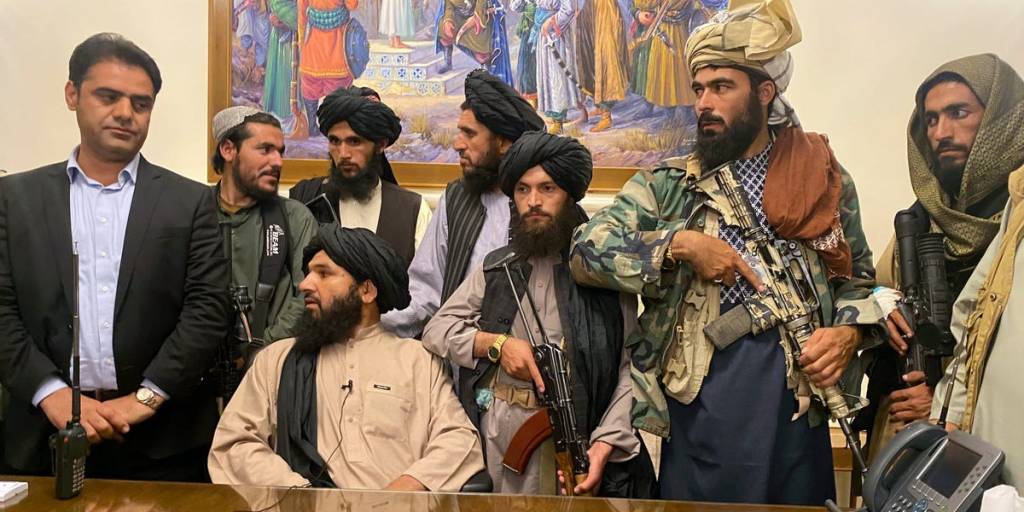
At the moment when the first photo about their triumphal occupation of the capital city and the presidential palace was taken, the painting was still there.
Here I can try to speculate about its presence or what happened that allowed that painting to still be fixed in the room, eventually some minutes or days after the photo was taken.
Just a curiosity, is it still there? And that room is still considered as the main office from where the Taliban leadership is supposed to be talking to the world or they had found a new space to do that, after the victory celebrations?
Still, concerning the Taliban case in the presidential palace, one can take further the speculation and formulate some hypotheses such as the one that imagines that the talibans had moved the painting from somewhere else to positioning it in that room intentionally. To those actions one pretends that they did it to try to rescue their credibility and reassure the international community. Could that be the case?
It is well known that one of the main concerns and worlds preoccupation about the Taliban’s actions, apart from the human rights issues, is their relation with the Afghanistan cultural and material heritage. So, one can speculate that they, following that speculation, had strategically moved or left the painting where it was located previously and decided to pose by having it in the background to address the worries of the international community.
So, by leaving it there they had pretended to say << we will not destroy any cultural and material heritage of your country, as you may see what we have on our background.>>
Considering that speculation is crucial to remind that once Foucault had suggested that “there were places where things had been put because they had been violently displaced, and then on the contrary places where things found their natural ground and stability.[3]”
In the case of the Taliban photo at the presidency place it seems that the painting was eventually “violently displaced” but for sure it was noticeably displayed.
Last hypothesis could be interpreted as the painting’s presence as an unwanted episode, because the celebration and the urgency to communicate their achievement and intention had blinded them to be able to see what was on their background while they were taking the photo and communicating to the world.
Then some days after, someone noticed the painting presence and then it was removed. Was that the case?
To try to find out what happened with the painting could be relevant to follow the next Taliban leadership interview or press conference. In that case the hypotheses could be that the painting is still there or is not, they may change the room, or to that wall we will see some other paintings and drawings. I hope that we may have a chance to verify that.
Here it could be important to mention that the removal of the painting from the wall or change of the room will happen mostly if there will be a significant sensitivity difference between the previous government and the Taliban leadership. Indeed, as Thorstein Veblen remained us that “the ground on which a discrimination between facts is habitually made changes as the interest from which the facts are habitually viewed changes.[4]”
So, it was a fact that the painting was in the room when for the first time the Taliban leadership communicated to the world from the occupied presidential palace. Before discussing why, the painting was still on the wall, it could be appropriate to take further the description of the second inspirational episode.
But as far as I know, few had been said about the artworks and artifacts present in the rooms. From there they made some photos that had then gone viral through the internet and traditional media channels.
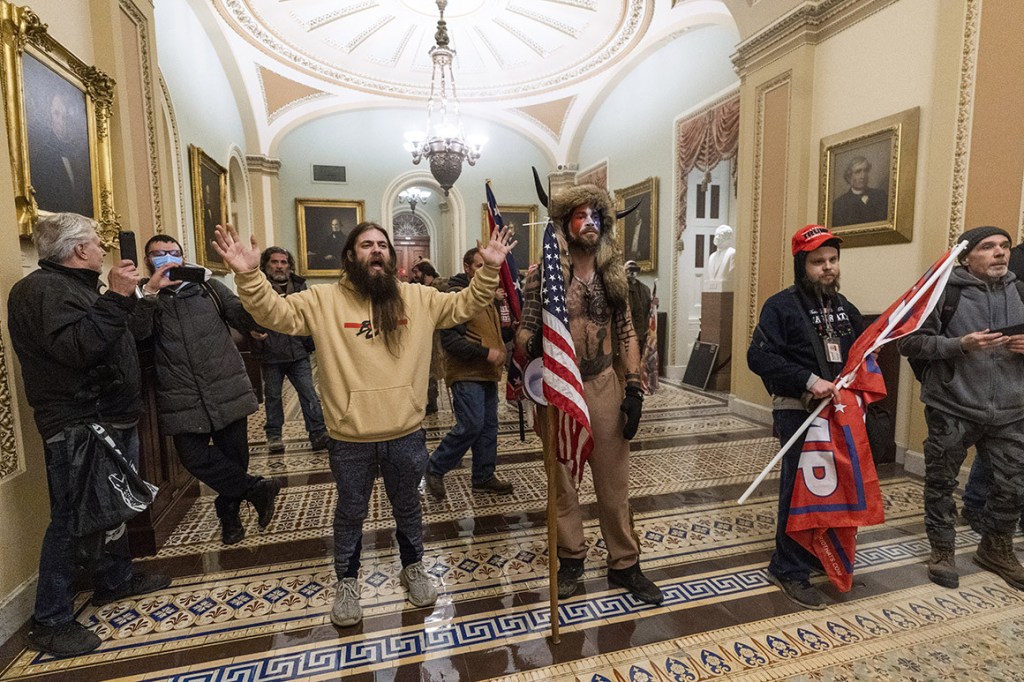
Here I come to the capitol riots, about which many things had been written and even some analyses of the hidden symbolic meaning of the demonstrators’ dress code, had been made.
About the riots, many more images had been captured and defused but I had chosen the one on which the demonstrators are standing in a room full of paintings and objects displayed.
Is very interesting that in the case of the capitol occupation there is no possibility to speculate about the presence of the objects on the photo background. For sure the demonstrators had chosen that room to make that picture exactly because they had realized the presence of those objects. It was like being pictured in front of those objects was able to give them another medium to communicate their message.
Eventually, the use that demonstrators had made with the objects and paintings located in the photo background is equal with those who often used to occupy the spaces of the capitol.
And here is the main thesis of my argumentation, in which I state that the paintings and the choice to have them in the background was the fact that somehow, they are a source of legitimation.
Indeed, both the old and new occupants of those spaces need the presence of those paintings and other artifacts to guarantee to them a legitimation for their acts and presence on those spaces.
Here it is important to remember that according to Max Weber there are three types of legitimate authority. Weber goes on describing them, affirming that “the validity of their claims to legitimacy may be based on rational or legal, ttraditional and charismatic grounds.[5]”
But it is important to mention that it seems that the authority is much more consistent if all those types of sources of legitimation are present.
And returning to the paintings and objects present on those spaces of power, I may mention that it is also their presence that make those spaces easily recognized as spaces of power.
Indeed, as Foucault reminds us “these are oppositions that we regard as simple givens; for example, between private space and public space, between family space and social space, between cultural space and useful space, between the space of leisure and that of work. All these are still nurtured by the hidden presence of the sacred.[6]”
In my understanding the sacred mentioned by Foucault is equivalent to the traditional mentioned by Weber, therefore those paintings and objects are present on the walls and displayed around to nurture these spaces and the person who occupies them with a certain sacred and traditional legitimation. Following this interpretation, it seems that even those who have, eventually, already the legal or the charismatic legitimation still need to be surrounded by art works and objects that reminds them of their traditional legitimation.
So, this paintings are present on those spaces to guaranty at least the traditional legitimation and whenever the persons has, for example, a legal legitimation they become invisible, but on the opposite they become visible whenever those who are lack of other types of legitimation use them to justify their actions and positions.
But what is most incredible is that this operation and exhibition of the source or signs of legitimation often happens within a circumscribed space. About the crucial role of spaces in daily-life interaction many things have been already written. Of those it seems that one of the most salient statement regarding the space and its relevance on humans existence was made by Foucault when he affirmed that he “ believe that the anxiety of our era has to do fundamentally with space.[7]”
That is once again one of the reasons why, eventually the main one, the paintings and other similar objects are still nowadays being displayed in the spaces and not only on the spaces of power. But are in the places of power where its symbolic meaning is most frequently activated for good or bad.
[1] Augé,1995:3
[2] Sontag, 1973:22
[3] Foucault, 1986: 22
[4] Veblen, 1957: 9
[5] Weber, 1947: 127.
[6] Foucault, 1986: 23.
[7] Foucault, 1986: 22
Works cited:
Augé, M. (1995). Non- places. Introduction to an anthropology of supermodernity (J. Howe, Trans.). Verso Books.
Foucault, M. (1986). Of Other Spaces. Diacritics, 16(1), 22–27.
Goffman, E. (1956). The Presentation of Self in Everyday Life. University of Edinburgh, Social Sciences Research Centre.
Sontag, S. (1973). On Photography. Rosetta Books.
Veblen, T. (1957). The theory of the leisure class. George Allen & Unwin.
Weber, M. (1947). Max Weber: The Theory of Social and Economic Organization (A. M. Henderson & T. Parsons, Trans.). The Free Press.
 Unexpected-Viewer