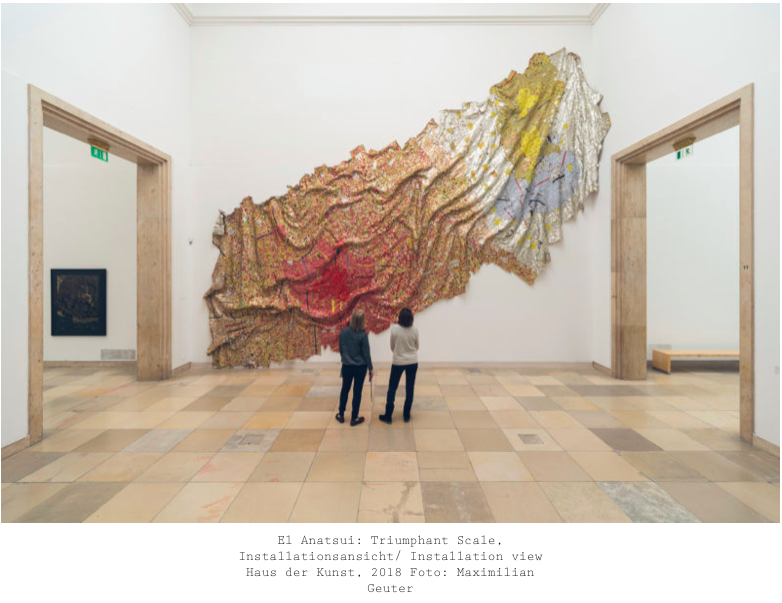
Here I’m at Haus der Kunst.
It seems that arguing about the historical and symbolical dimension of Haus der Kunst could not be the right thing to do here, also because there are already so many writings about the topic.
But I cannot avoid to briefly talk about the venue in relation to the El Anatsui exhibition that is currently on display, also because it could be relevant to mention that Haus der Kunst had a central role on the construction and diffusion of the so called German pure art during the Nazi times.
After the Nazi-fascist era, the museum became engaged in a process of transformation from place where exclusiveness was being constructed and a place in which same walls are available to display “excellent” art “from everywhere” in the globe.
Eventually it was during this processof transformation and devolvement , from the “Haus der German Kunst” to the actual “Haus der Kunst”, that an intellectual and a curator like Okwui Enwezor chose to direct it for a couple of years, from 2011 to 2018.
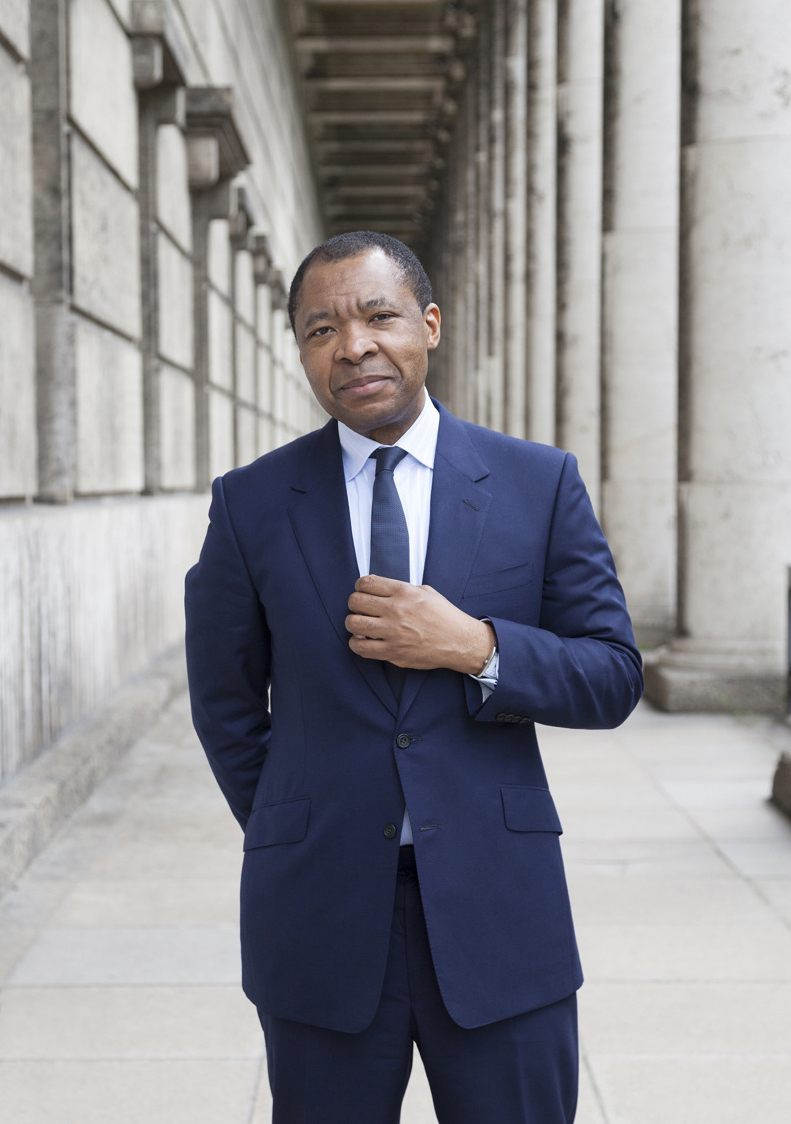
Also, it could be relevant to mention that it was under Enwezor’s directorship that the El Anatsui retrospective was scheduled.
Anatsui and Enwezor have a such strong and longstanding relationship that it was not surprising that the exhibition took place.
In relation to his, I would like to remind you that it was also under the directorship of Enwezor, this time as an artistic director, that El Anatsui was awarded with the golden Lionel for Lifetime, of the 56th edition in 2015.

Now, here we are, May 2019 some months ago Okwui Enwezor passed way, and El Anatsui is back to the Venice biennale this time, within the context of the very first Ghana national pavilion, and since 8 may his exhibition is on display at the Haus der Kunst.
It was curated by Okwui andChika Okeke-Agulu. The two curators and scholars had also, previously, made some significant and outstanding projects and initiatives together. I hope that very soon I will have a chance to talk about the art journal that they had created, with other scholars, some years ago, its name is Nka journal of contemporary African art .
El Anatsui exhibition at the Haus der Kunst is being considered to be the last show curated by Okwui Enwezor. So it is also somehow the Enwezor last curatorial sign.
Therefore, considering all the aspects that I had mentioned above the ‘El Anatsui: Triumphant Scale’ is a verysymbolic and significant show for the venue, artist and its curators. I am quite sure that in a near future it will be considered as ‘canonical exhibition’ in Bruce Althusser sense.
Or at least for me also, it was or is!
When I visited the show I was coming from Venice and going to Kassel.
On the way I planned to stop in München, the German city here Haus der Kunst is located.
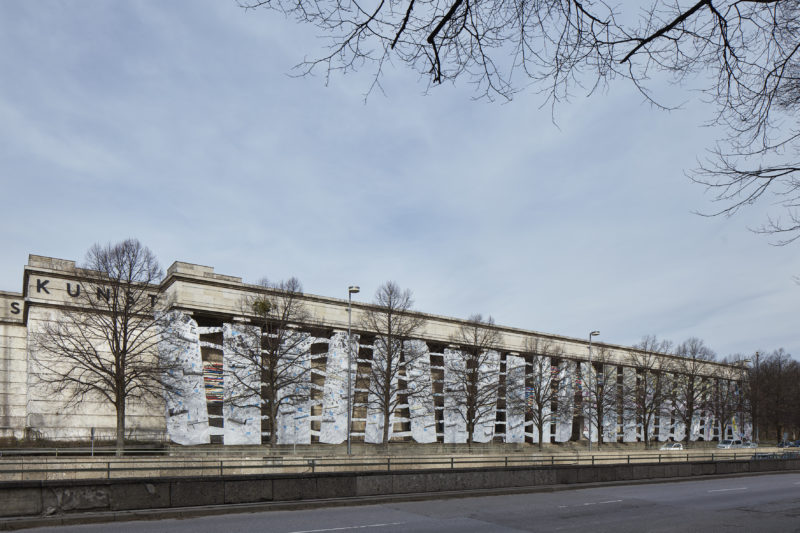
I just arrived to the venue of one of the Anatsui works: “Second Wave” that is part of the few commissioned works for the exhibition, covering the facade of the museum, and so becoming the first sign of the magnificence of the show and at same time what the show is about: Transformation.
Indeed what could be more transformative than ‘climbing the stairs to triumph’?
The exhibition is a retrospective, one of the most complete, of El Anatsui, an African artist from whose work it is necessary to make a great effort to guess where he is from.
Indeed by looking for the installation at that the facade one could not guess easily where the artists is from.
So you could ask: Is that positive or negative?
Right now I don’t know, but some years ago, and here I’m going back to the concept of Art from know where’ that I had mention at the beginning, by visiting large-scale international exhibitions I had imprudently developed the concept of ” art from nowhere” to identify and classify the art works that the viewer cannot guess easily where the artist happen to born.
So that is the effect that I had with and looking at the installation of Anatsui in front of the Haus der Kunst. My first question was << is this installation part of the Anatsui exhibition?>>
Yes it was!
Then, if happens that the entry at the exhibition venue, from the first step in, the architecture and curatorial arrangements are able to capture and to communicate very well what the exhibition is about.
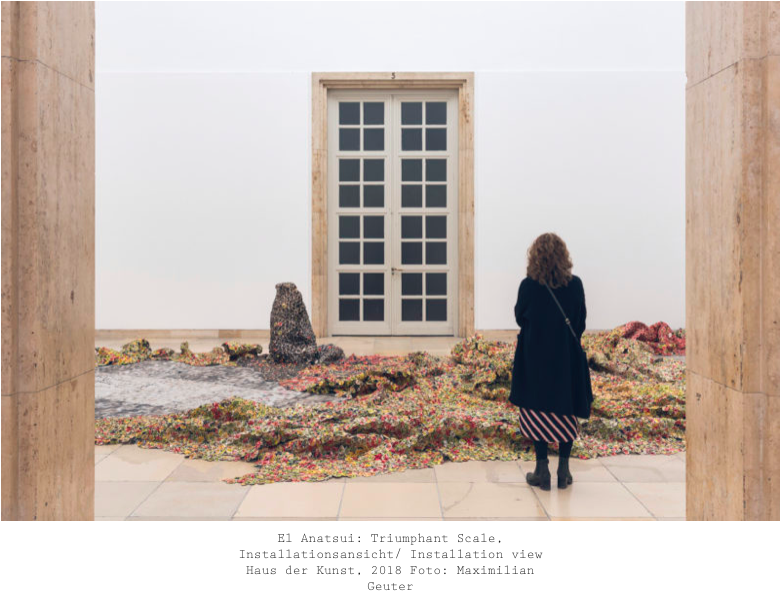
But let’s go step by step.
Works, display and labels are distributed among the 11 galleries in a magnificent way.
On the walls, one can feel the Enwezor hands and thoughts, but there, as always his presence is being expressed through the artist’s voice. Which means that the main voice is the one we can hear in the show, through the Anatsui voice, but at same time the curators voice(s) could also be heard.
Entering on the galleries.
In the first gallery, one finds one of Anatsui’s most famous work the “Man’s Cloth, 2001.
In this gallery are also included other two works: Sasa, 2003 and Dusasa II,2007.
I would like to anticipate that the works are present in the galleries though a quasi-decrescent chronological order. Therefore, walking to other galleries means being exposed to older works, with different practices and materials. And by doing that one can get a sense of the Anatsui artist’s career.
There are 11 galleries and more than 50 works from large to small scale ones.
I will not describe all the galleries here. You must visit the exhibition if you have a chance.
But randomly I will describe or share some reflections that I had upon entering in some galleries.
Of course, this descriptive and reflective commitment is unavoidable, so I will start from the first gallery.
Also because is the first gallery is located after the entrance.
So one’s entry to the gallery 1 right before see and maybe read the title of the exhibition that is written on the entrance in big letters: ‘El Anatsui, Triumphant Scale.’
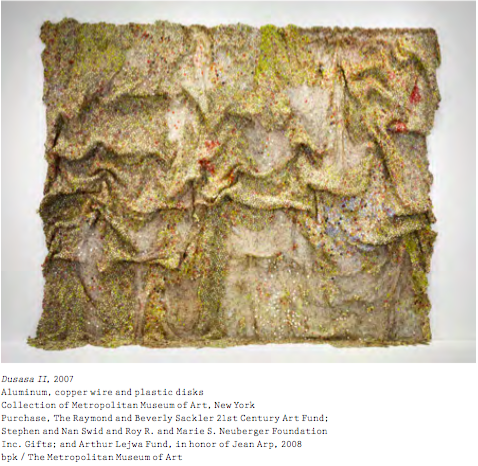
And if you are like me, since then you would start to think about the triumphal dimension that is been evoked or claimed in the exhibition.
Could it be possible that most of us will try to make sense of the ‘triumph’ trough metaphysical or religious terms or as it is fashion today in a shamanistic or why not even magical terms, and the latter category can easily take us to the past exactly to the one of acclaimed and at the same time criticized exhibition “Magicians de la terre” curated by Jean-Hubert Marten at the Centre Georges Pompidou.
Here could be relevant to remember that Okwui Enwezor was one of those African curators and intellectuals that had strongly criticized the curatorial choices of show.
I had mentioned the categories above because, unfortunately those categories or metaphors, until now, are often being applied to make sense of art works made by an African artist. Why? Unluckily here is not the right place to argue about that very important issue, that is crucial in the process of the contemporary African art reception outside the continent.
So let’s move on, upon entering on the first gallery, I am still trying to identifying the best frame trough which I may make sense of the dimension triumph evoked by the exhibition title and somehow translated though the artworks included on the show.
And from the first gallery, the art works and the curatorial arrangements start to provide some of the answers or frames.
The arguments, themes or titles of the art works, the materials, how the medium and compositions are capable to challenge a previous idea that one could have about them.
And it means that Anatsui was able to challenge the previous ideas about the medium: in other words some of my questions was <<what is this? How I can classify it: Is it sculpture? Or is this an installation? So, the works on display in the first gallery are able to show that Anatsui had created a works that somehow, in a sort of accumulation of the previous ones, takes the viewers to a new stage, and presents forms and compositions that had never been achieved before.
And it is better to remember that in this gallery are displayed only three works.
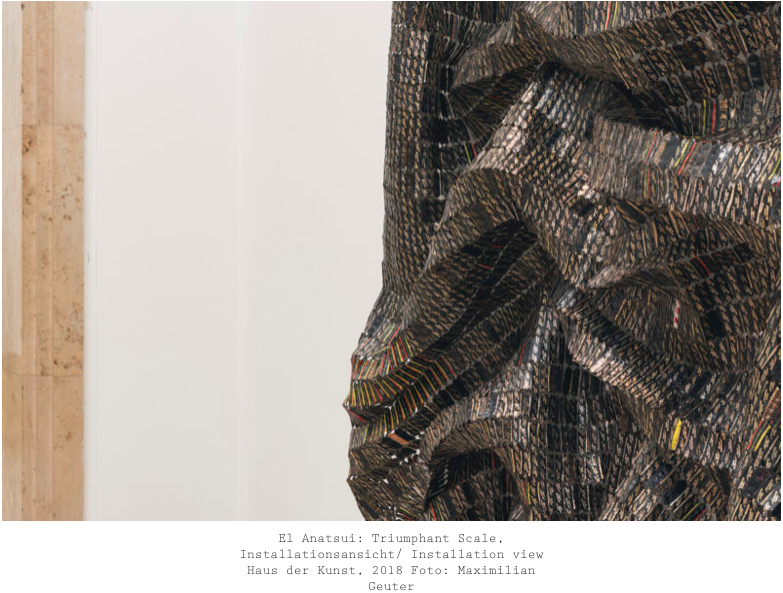
Other very interesting fact is that in the first gallery, the way and how the labels are located in relation to the art works is wonderful. At least I like it!
One can look or try to see the details of the works and not be able to see the labels because they are incorporated in a way that does not interfere with the art work displayed.
As I said above I will not describe all the galleries. You must go and see the exhibition or at least wait for the catalogue that will be available from next mount. June 2019.
And follow the order of the exhibition arrangements, once on the second gallery it seems that all eventual questions influenced by the title or preconception get an immediate much more complex and quasi-complete answer.
At least I got one!
The triumph that is been evoked is not the one that can be captured, experienced or achieved trough metaphysical or religious lens.
In my opinion, once you see the labyrinthine installation << Logoligi logarithm,2019>> that is located at the second gallery, one realize that the triumph evocated here is the one related to the fact that El Anatsui works can call the viewer to look, interact with them without pretending to take you for one specific place or idea.
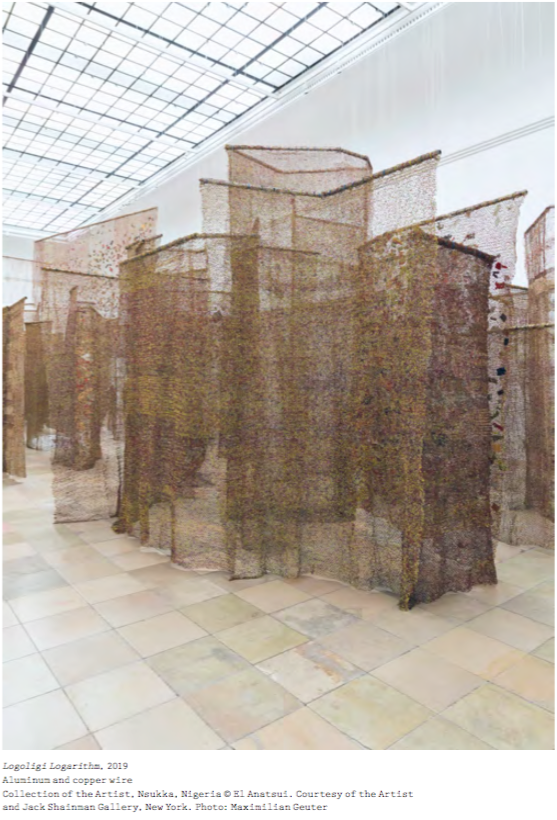
That is not to say that the works are not engaging or that do not express an idea. What I’ m saying is that the work(s) are able to communicate with everyone without a pretence to having all the answers to everything.
To better explain it I can borrow some Nelson Goodman thoughts when he said that there are works that “ [saying] nothing, [denoting] nothing, pictures nothing, and are neither true nor false but shows much.” (Goodman, 1978)
So is that a triumphal achievement or not at all!?
One other very important aspect that can reinforce this interpretation is the absence of sound. Why it was not included?
Entering others galleries, the dialogue between the viewer and the works goes on in same manner, ‘in a silent way’!
And continuing to walk to other galleries, in front of some of the Anatsui old works included in the show one could start to ask: why did I not follow him since the begging of his career? Or at least since I started to work in the art field?
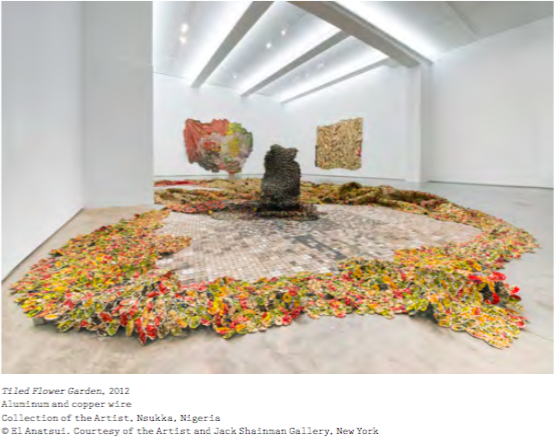
And eventually about this issue, one gets a sort of comfort because of the labels of the works. You can also see who owns them. Which institutions and privates individuals are the collectors of the Anatsui works. And walking around you realize that they vary from the local ones those like <<Therese Balisle-Nweke, from Lagos, Nigeria>>> to the international ones, like British museum or Metropolitan Museum of Art>>
So it seems that everyone( institutions included) that pretend to play a significant role in the artworld is somehow associated with the Anatsui works. There are also some galleries like the London-based October gallery and the newcomers like Guggenheim Abu Dhabi.
But to conclude this brief review of the show, related to the ownership of the works includedit, I was glad to see that a significant number are part of the artists personal collection, so that could mean that very soon we will eventually have in ” everywhere in the globe, as well as his works can be from everywhere, an El Anatsuimuseum.
And this could be one further step on the scale of triumph that Anatsui, will for sure continue to climb, unfortunately from now without one of intellectuals and curators that had worked side by side with him: Okwui Enwezor.
But for sure he will not be alone in this process.
That is why I consider the career of El Anatsui as a silent journey made the many steps
The exhibition is on display until 28 July 2019
‘El Anatsui: Triumphant Scale’
Haus der Kunst, Munich, 08.03- 28.07 2019
Discover more from Unexpected-Viewer
Subscribe to get the latest posts sent to your email.
 Unexpected-Viewer