It happened that I was in Frankfurt. The many things that I saw at the exhibition that I am about to review here could very well have been displayed elsewhere in the world and still be relevant to how it was here at the TowerMMK.
And this was not only related to the fact that most of the artists and collectives included in the show are part, at least most on them, of the so called club of “the international artist”. This club includes those few artists that are often included in all shows that pretend to have an international grounding.
But as I have mentioned above, the art works and mostly the exhibition topic is relevant in many part of the world because as always, the globe is indebted to and somehow characterized by the movement of people, irrelevant of the reasons for this movement.
At this point I can anticipate that the exhibition is about, in my understanding, migration and belonging in contemporary Germany. So by including in it artists from diverse practices, generations and backgrounds that are nonetheless based in Germany, the curators did one of the many well-made curatorial choices.
I decide to visit the exhibition for many reasons: I was curious about the theme and the artists included, some of whom I had just seen at the last documenta back in2017. And last but not least the location: The TowerMMK, the newest venue of the Museum für Moderne Kunst located in Frankfurt am Main. It was opened on 2014.
At this point I would like to mention that the exhibition was curated by Sussane Pfefferand Anna Sailer. Sussane Pfeffer is currently the director of the MMK since 2018 and Anna Sailer is a researcher with a PhD in art history from the Gottingen University. Both curators are trained in Art History.
Also, all exhibitions that are currently on display at the three MKK venues are the first under the Sussane Pfeffer directorship.
The TowerMMK is in the top of the tower on the last floor, and to arrive there one must take the lift or the stairs. But first of all, one has to pass through a great hipster bar <<Elaine’s Deli.>>
So one of the temptations or one of great thing of the TowerMMK is the bar on the first floor because one can find himself asking what to do first? << visit the exhibition first or stop here>> or <<have some café and listen to good music? or go up there?>>.
It is relevant to mention that in the bar, the visitor can have the chance to taste a beer created and branded by an artist included in the show, Emeka Ogboh and it seems that the beer project was also included in the last documenta 14. So somehow, the stop at the bar was taken into consideration by the curators. The dilemma was whether to do it at the begging or at the end of the visit to the show?
But art always comes first!
So going back to <<Because I live here.>>
Right after I entered into the exhibition venue, I picked up the exhibition booklet. Impacted by the curatorial statement, I stopped and read the exhibition title again<< Because I live here.>> . Then my phenomenological question was: So what?
I took a few steps before the entrance and I started to hear a sound that was coming from the first art work that all visitors encounter. Fantastic!
Actually, I can say that the location of that piece, right in front of the entrance was another great curatorial choice adopted in the exhibition, because, even the most hushed visitor will experience something in common with the slowest visitor and with those who are motivated. So everyone will gather in front of at least one piece. And this is great achievement!
Because for those who are used to visiting art shows with friends, can certainly remember the time when we were surprised to know that our bodies with whom we went to an exhibition did not see the artwork we were referring to in a later conversation.
In this exhibition, this couldn’t happen!
Off course there would still be differences in the time spent in front of the artwork, but that is another issue!
So one stops in front of the first piece, as this case in film about let’s say a ‘self-presentation performance.’
I stopped in front of it not only to see it, but to organize my ideas about what I was just starting to see and hear.
First thing that I was trying to do was to quickly reflect on and to understand the implications of the exhibition title:” Because I live Here.”
But let’s start with being descriptive and then being more reflective.
So going back to “Inventory-Metzstrasse, 11” a 9 minutes film made in 1975 in Munich.
It shows how and whom used to be the newcomers in Germany of that time when the film was being made and how and where the people used to live and what were their aspirations in terms of work and house.
It is also useful to understand why these people came to or went from Germany, depending on the perspective in which one positions himself while watching the film.
One of the so called <<guest workers>> along with some members of their families are present themselves in the film: name, country of origin, work or work aspirations and housing conditions.
The order of the arguments that I am presenting here does not follow the exact order mentioned in the film because not all of those who had been in front of the camera had answered the questions in the exact same manner: The kids are one example!
So the (Gasterbeiter) in the Želimir Žilnik film are able to express their living conditions in a very elaborated way that informs us as to ‘pulling factors’ that had motivated them to come to Munich in that exact time and space.
And for me, only by seeing this video, I was able to have some grounds to make sense of the statement <<Because I live Here.>>
The exhibition is constructed around the works of eleven artists and artist groups.
Mostly the art works included in the show can be generally described as mixed media.
But let’s go back to the exhibition entrance.
So going back to the exhibition <<Because I live Here.>>
We are still in front of the Želimir Žilnik film and after it, there is one of the most critical curatorial choices of the show. The dilemma relates to the way of going back again, because if the visitor continues to walk forward, they will find two other videos: one made by Harun Farocki and other made by Azin Feizabadi. But if the visitor decide to walk back away from the video screen, they will see a door covered with curtains that directs them to the Emeka Ogboh installation. Do you still remember about the beers on the first flaw bar?

Yes its seems that the choice is actually between continuing to think and find the answer for the exhibition’s many claims or to just have fun because in the end, everything gets solved with a couple of beers.
Actually I think that for this type of exhibitions, especially considering the content and the varying narratives, statements, and aims, the curators could not give the back door option to the visitors.
The visitor must reflect and experience pain and discomfort proposed by some artworks and then have fun by through the process of identification, subversion, all well-made by the Emeka installation and its overall project <<Sufferhead Original (Frankfurt edition), 2018).
It seems that psychological research has proven that change comes easily trough pain.
However, there are exhibitions that could be about some neutral or not too painful and reflective arguments, where the works included are somehow like the one made by Azin Feizabadi entitled << Cryptomnesia.>>
But <<Because I live Here>> is an exhibition where the visitors could not be ‘allowed’ to freely go around and get only what he/she wants.
I think that somehow, the curators and exhibition designers, have clearly helped the visitors to understand that not all the routes can be helpful to better understand or make sense of the exhibition theme or content.
So for the next time, the visitors must be guided through the exhibition, they must be offered the possibility to easily understand and make sense of the curatorial statements. Because not all the voices present in the exhibition space are able to offer a very clear answer to what the visitor thinks that the exhibition is about.
So I went backward, and the I had a feeling that the right direction to go was forward!
Indeed, right after the Žilnik video, the Harun Farocki video is displayed. It is16 minutes long and if I remember well, it is titled<< In-formation>>> and in it, numbers about migration-related issues are presented. Both of the videos may not only identify the pulling factors of guest works ( Germany’s need of labor, the conditions in the home countries of guest workers), but must importantly how this process of people’s movement from one place to another is embedded in historical circumstances and how, somehow, the host places or countries had contributed to creating some pushing factors in the home countries.
That is the case? I don’t know ! But by seeing and analyzing the charts and diagrams presented in the Farocki film this was one of the things that I was able to acquire.
Through this work, Farocki can be considered an artist that had assumed his position as a producer. Indeed, according to Walter Benjamin in one of his most famous article “The author as a producer”, the artist that is simultaneously producer does not only try “ to supply a productive apparatus without changing it”( Benjamin, , 1943, 304). And he goes one affirming that “a work that shows the correct political tendency need show no other quality.” (ibidem, p.127)
Indeed, since I saw Farocki infographic video, the claim, and the need to claim express the starting question clearly and the phenomenologically-driven question<< so what?>> starts to have some answers.
Other works are displayed in different spaces of the venue.
Related to the works and the experience of visiting the exhibition another drawback of it is that one realizes by walking around, that it is difficult to identify the works even if one uses the map that is available in the entrance. here are some exhibitions in which the captions are not important but << Because I live here>> is not one of them.
So to include or not to include labels and where to located them?

Going out from the exhibition, we can remember that the labels issue was one of the hot topic of the last documenta and by coincidence some of the artists that are included in this show had been also displayed on the documenta 14. So what is going on here?
Returning to the exhibition, the works don’t have any caption or label to introduce them or even to let the visitors know who made them.
So the crucial questions could be is be absence of caption able to influence how a visitor experiences an artwork? I don’t know but to memorize or solve some doubts is certainly important. I am aware that this issue is being discussed in mediation studies but in the meantime, one solution could be to include just the name of the artist or collective.
Maybe it is by having that potential gap in mind that the museum has some great invigilators (security people you mean? or guides????) like Mrs. Mona Khumar that often helps the visitors identify the works and suggests to them to go back to the entrance and take the exhibition map.
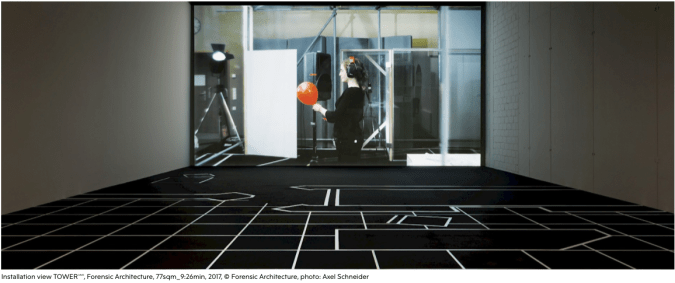
Arriving at this point, I would like to clarify that my goal here is not to describe, mention or eventually comment about all the works that were included in the show also because as I had just mentioned above, most or even all the artists shown are well-known and somehow acclaimed artists such as the collectives SPOTS and Forensic Architecture.
Before concluding, I want to name all the artists and collectives that are included in the show, included the ones that I had mentioned above: Harun Farocki, Azin Feizabadi, Forensic Architecture, Natasha A. Kelly, Erik van Lieshout, Henrike Naumann, Emeka Ogboh, spot_the_silence, SPOTS, Hito Steyerl, Želimir Žilnik.
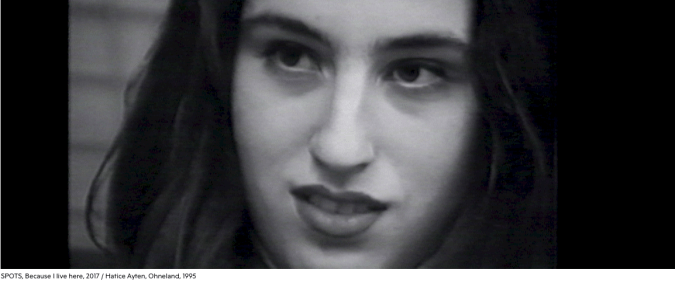
But I cannot end the present review without saying a word about one of the videos included which was made by the collective SPOTS, mainly because it is the source of the exhibition title.
<< Because I live here, 1995/2017>> is a about a woman that was talking, actually it was an interview, about how and what she is used to experience in her daily life in different spaces and circumstances. For the interview she was talking about an episode that happened in two German cities Mölln (1992) and Solingen (1993).
By watching it, it is possible to understand that the sources of acceptance, as in to be accepted as a full member in some contemporary society had changed.
Belonging is something that one have to constantly show, claim and also justify.
Therefore the exhibitions is a great start points to think about the question <<what does it mean to belong to and in some societies? >> and it can be encapsulated in the question <<how can one acquire and articulate the sense of belonging?>>
And by watching video one can realize that some traditional categories or criteria though which the belonging was previously constructed and recognized are not relevant anymore.
Indeed according to the video in the, let’s say, contemporary German society, it is not enough anymore to have the country’s passport or to speak the language to be considered a full member of society.
And if we relate the inputs that we gain in these videos with the other inputs from the artworks included in the installation of Forensic Architecture or with others videos from spot_the_silence we can conclude that some older essential and ascribed characteristics are becoming again dominant, like the criterion needed for the definition and recognition of belonging to some society even if somehow the criterion is outdated.
So when happen to be asked <<why?>> which is the permanent combat those that are not easily recognized, I no other have no other choice than to answer <<Because I live here.>>
And for those few who will pretend to take the conversation or confrontation further by asking <<so what?>>
Nothing would be more convenient than to say that <<those who live in one place are also contributing to what the place is and has.>>
TowerMMK, Frankfurt main.
27 October- 21 July 2019
Discover more from Unexpected-Viewer
Subscribe to get the latest posts sent to your email.
 Unexpected-Viewer